Last updated: November 19, 2026
Key Takeaways
- A teen allowance is planned money from parent to teen, usually weekly or monthly, with clear rules.
- Set it up by choosing one purpose, one amount, one payday, and one shared agreement.
- Allowance and chores are usually separate for money skills, though chores can stay in the family deal.
- The rules should spell out categories, limits, and exceptions before the money is spent.
A teen allowance system works best when it has a clear purpose, a simple rule for getting the money, and a written agreement. This article on allowance for teens: how to set it up and use it gives a practical framework for families. The point is not to “pay kids to be good.” The point is to give a teenager predictable practice with spending, saving, and choice.
What an allowance is for, and what it is not

An allowance is a planned transfer of money from parent to teen, usually on a set schedule like weekly or monthly, with rules attached. It is not a reward for being a pleasant person, and it is not a substitute for teaching money habits. If the money has no job, it turns into background noise.
Before setting one up, decide which job you want it to do:
- Practice allowance: the teen gets regular money to practice basic money decisions. This works well when the goal is learning to manage a small budget without a lot of strings attached.
- Responsibility allowance: the money is meant to support growing independence, such as buying lunch extras, snacks, or clothing top-ups. The teen is expected to manage those categories.
- Rewards-based allowance: the allowance is linked to specific tasks or behavior, often with a chart or checklist. This can work for younger teens or for short-term goals, but it can also turn into constant bargaining.
The mistake most families make is mixing all three models at once. A teen cannot tell whether the allowance is for learning, for household contribution, or for performance if the rules keep changing. That confusion creates arguments over $10 or $20 that are really about expectations.
If the family wants a system that teaches money handling, the allowance should come with three fixed parts: a schedule, a purpose, and a few spending rules. For a broader framework on teaching money skills, the how money works for teens hub belongs nearby; this page stays on the allowance system itself.
How to set up a teen allowance system
Set up the teen allowance system by choosing one purpose, one amount, one payday, and one agreement that both sides can say out loud. The process is simpler when it is written down in a single page instead of handled as a series of reminders and renegotiations.
- Pick the purpose first. Decide whether the allowance is for practice, responsibility, or rewards. The result should be a system that answers one question: “What job is this money doing?”
- Choose the payment schedule. Weekly works well for younger teens who need frequent feedback; every 2 weeks or once a month works better when the teen can plan ahead. The result should be a predictable payday, like Friday after school or the first of the month.
- Set the amount with a real use in mind. Tie it to the decisions the teen will actually make, such as snacks, school supplies, or part of a clothing budget. The amount should match the goal, not a parent’s mood.
- Write the spending rules. Decide what the allowance covers and what it does not. For example: “The teen handles small personal purchases, while transportation and school fees stay with the parent.”
- Name the saving rule. A common structure is to split money into three buckets: spend, save, and share, or spend, save, and future goal. The exact percentages matter less than consistency.
- Create one review point. Revisit the system after 8 to 12 weeks. The result should be a small adjustment, not a full reset every time somebody regrets a rule.
Put the agreement on paper or in a shared note app. A one-page family agreement is enough. If the teen can read the rule in 10 seconds, the rule is probably written clearly enough to enforce.
Should allowance be tied to chores?

Allowance and chores should usually be separated if the goal is teaching money management, but chores can still be part of the family agreement. That distinction prevents every sink, basket, and trash can from becoming a billing dispute, though families should consult a financial or family professional if they want help setting a fair rule.
Here is the cleanest split:
- Chores = family contribution. Basic shared tasks such as clearing dishes, taking out trash, or loading a dishwasher belong to the household. These are not “extra” jobs in a home.
- Allowance = money practice or responsibility. The teen learns to handle a fixed amount on a schedule.
- Extra chores = optional paid work. Bigger jobs, like yard work, deep cleaning a garage, or helping move boxes for 45 minutes, can be priced separately if the family wants a pay-for-work model.
This setup avoids a common trap. If every chore earns money, a teen may start treating normal household participation like a gig economy shift, though families should consult a professional if they are unsure how to keep expectations realistic. That can make basic cooperation feel optional. On the other hand, if chores are never connected to money in any way, a family may struggle to create short-term incentives for unusual tasks.
A practical compromise is to keep the base allowance unconditional and use paid extras only for tasks outside the normal routine. That gives the teen one stable amount to manage and one separate way to earn more.
This is the wrong model for families that want all money to be earned. It is also the wrong model for homes with ongoing conflict over chores, because attaching cash to household labor can make disagreements more intense, not less. In those cases, a plain chore list with no pay attached is usually cleaner.
What spending rules should go in the agreement?
The spending rules should cover categories, limits, and exceptions so the teen knows what the allowance is for before the money disappears in one weekend. A good agreement answers three questions: what is covered, what requires parent approval, and what happens if the teen runs out early.
Useful rules to include:
- Covered by allowance: snacks, entertainment, small impulse buys, personal toiletries, or school extras under a set limit.
- Not covered by allowance: family groceries, medical costs, required school fees, or transportation the parent has already promised to provide.
- Approval required: purchases over a chosen threshold, such as $25, or anything bought online.
- Time rule: a teen can wait 24 hours before buying nonessential items above a certain amount.
The value of a spending rule is not that it controls every dollar. It is that it reduces debate after the fact. For example, if the agreement says the teen is responsible for lunch extras but not for basic lunch money, the parent does not have to renegotiate the distinction every week.
Do not make the rule so narrow that the teen cannot make any decisions at all. A system where every purchase needs approval teaches dependence, not budgeting. Do not make it so loose that the teen has no category limits. A system where “it’s your money” is the only rule can leave the teen with little guidance and a lot of short-term spending.
If the teen regularly overspends in one category, the answer is not to abandon the system after 1 missed week. The answer is to tighten the category, lower the discretionary amount, or move to a monthly schedule so the teen has to plan for longer stretches.
How to build saving rules without turning the allowance into a lecture
Saving rules should be simple enough to follow in 5 minutes and visible enough that the teen can see progress toward a goal. The goal is not to create a perfect saver; it is to make saving a normal default, not a dramatic event.
The easiest structure is a 3-part split:
- Spend now
- Save for later
- Save for a specific goal
That third bucket matters. A teen who only hears “save money” may have no reason to care. A teen saving for a concert ticket, a pair of headphones, a game, or a class trip can connect the delay to a real result.
A family agreement can set a rule like this: at least 20% goes to saving, or a fixed amount such as $5 from each payment goes directly into a goal bucket. The exact figure is less important than the habit of moving money before it gets spent. If the amount is tiny, the habit still matters; a $3 transfer repeated over months teaches more than a vague promise.
Do not turn saving into a punishment. If a teen wants to spend every dollar immediately, the family can limit what the allowance covers, but the saving rule should stay framed as a tool, not as moral correction.
A teen does not need a bank lecture to understand this. The teen needs a plain rule, a labeled jar or app category, and a goal that can be named in one sentence. That keeps the system concrete.
For parents who want a broader money-skills path, this allowance structure fits inside the larger how money works for teens topic without replacing it.
Common mistakes that make allowance fights worse
The biggest mistakes are vague rules, inconsistent paydays, and changing the system after every argument. Each one carries a cost, and each one has a better replacement.
- Changing the amount every week: this makes the allowance feel like a negotiation, not a system. The fix is to keep the amount stable for at least 8 weeks before revisiting it.
- Using allowance as a punishment tool: this turns money into a behavior report card. The fix is to handle discipline separately from the allowance unless the family agreement clearly says otherwise.
- Expecting the teen to infer the rules: this creates repeated conflict over what counts as “covered.” The fix is to write examples into the agreement, such as “snacks yes, streaming subscriptions no.”
- Making the amount too large too soon: this can hide bad habits because the teen never has to choose. The fix is to start small and increase only after the teen shows steady handling of the current amount.
- Skipping the review: a system that never gets checked becomes stale. The fix is a 15-minute review every 2 or 3 months.
A flat number with no purpose is usually the weakest version of allowance. It teaches little, and it creates the most arguments. A named model—practice, responsibility, or rewards—works better because the family can judge the system by its own purpose.
A simple family agreement template that actually gets used
A family agreement should fit on one page and be short enough to explain in under 2 minutes. If the document is longer than 1 page, it usually has too many exceptions to survive real life.
The agreement can include these lines:
- Purpose: “This allowance is for practice / responsibility / rewards.”
- Amount: “The teen receives $____ every week / 2 weeks / month.”
- Covered items: “This money covers ______.”
- Not covered: “This money does not cover ______.”
- Saving rule: “At least ____ goes to saving or a goal.”
- Chores rule: “These chores are family jobs: ______.”
- Extra work rule: “These extra tasks may be paid separately: ______.”
- Review date: “We review this on ______ after about 8 to 12 weeks.”
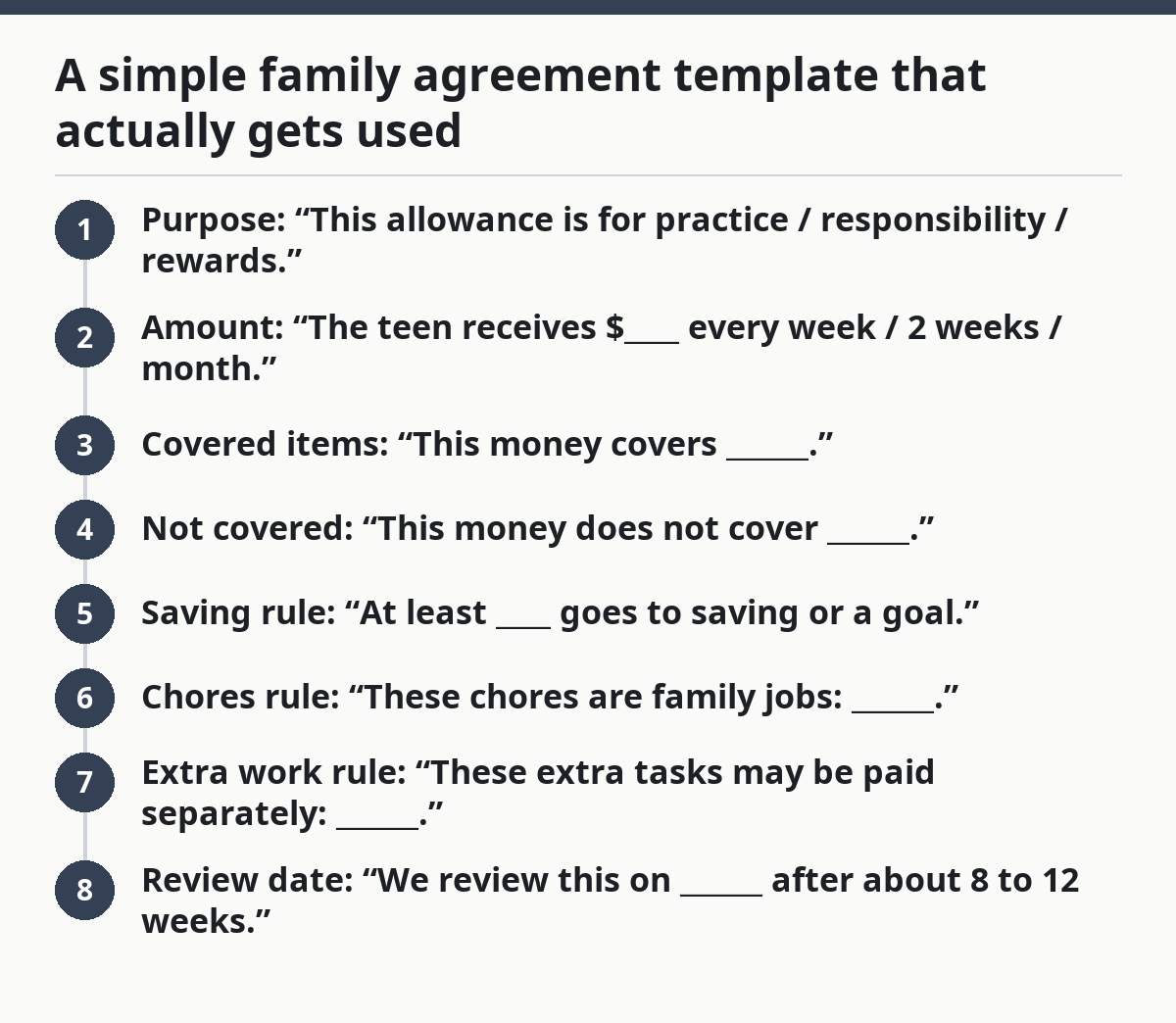
That format works because it removes guesswork. It also makes it easier to change one line without reopening the entire arrangement. If the teen earns a bigger clothing budget later, the family can edit line 3 instead of rewriting the whole plan.
A useful agreement is plain enough for a 13-year-old to read, but specific enough to survive a 16-year-old’s questions. That is the standard worth aiming for.
When this system works best, and when it does not
A teen allowance system works best when the family wants predictable practice with money, clear boundaries around chores, and a low-drama way to discuss spending. It works poorly when the parent wants the allowance to fix every behavior problem or when the household cannot agree on what money is for.
This is not the right model if:
- the family wants every chore paid individually,
- the teen needs no practice because all spending is already fully parent-managed,
- or the adults in the house cannot stick to a payday or a rule for more than a few weeks.
It is also a bad fit if the allowance becomes a substitute for conversation. Money rules work only when the family can talk about them calmly enough to keep them steady. The system should reduce tension, not become another weekly argument.
For families that want a structure with fewer surprises, the most workable version is simple: one purpose, one schedule, one agreement, and one review date.
Should teens get an allowance?
Yes, if the goal is to give them regular practice with money decisions in a controlled setting. An allowance can help a teen learn how to handle spending, saving, and waiting without turning every purchase into a crisis. It is less useful if the family uses it as a substitute for teaching or as a reward for normal behavior. For background on teen money habits, see the Consumer Financial Protection Bureau and Money as You Grow.
How much allowance should a teenager get?
The right amount is the one that matches the job the allowance is meant to do. A practice allowance can be small and steady, while a responsibility allowance may need to cover more real expenses like snacks, clothes top-ups, or extras. The amount should be tied to what the teen is expected to manage, not to a fixed rule that ignores the household’s budget.
Should allowance be tied to chores?
Not usually, if the goal is financial education rather than payment for household labor. Chores are part of family life, while allowance is a money system with its own purpose. A better setup is to keep routine chores separate and pay only for extra jobs that go beyond normal expectations.
Drafted with AI; not yet reviewed by a person.