Last updated: November 19, 2026
Quick answer: use 1 bank locator first, then filter for the exact task: branch service, cash deposit, or cash withdrawal. This guide to How Teens Can Find a Bank Branch or ATM That Works With Their Teen Account keeps the search focused on the location that matches your teen account’s limits on deposits, withdrawals, or card use, because a nearby ATM is not enough if it cannot do the job you need done.
Key takeaways
- Start with the bank locator, not a map app, because the locator usually shows which locations take deposits and which are ATM-only.
- A branch is often the safer choice for account questions, cash deposits, or anything that needs staff help.
- An ATM is often best for quick cash withdrawals, but it may not accept cash deposits or work outside your card’s network.
- Hours matter as much as distance. A branch 10 minutes away is useless if it closes before you get there.
- If the locator does not mention teen account support, call the branch before you go.
How do I find a branch or ATM for my teen account?
Use your bank’s locator and sort by the exact service you need, because “nearby” does not always mean “works with your teen account.” A branch locator usually lets you search by ZIP code, neighborhood, or city, then filter by branch services, ATM access, cash deposit, or cash withdrawal.
Start with the bank’s own site or app before using a general map. Bank locators are often more reliable for this task because they can show details a map pin will not, such as lobby hours, drive-up ATM access, or whether the machine accepts deposits. The Consumer Financial Protection Bureau explains that bank account terms and service rules can vary by institution, so the locator is only the first check, not the last one. See the CFPB’s bank accounts overview and the FDIC consumer resources for general guidance.
After that, read the location details line by line. Look for words like “deposit-taking ATM,” “full-service branch,” “cash deposit,” “cash withdrawal,” or “walk-up ATM.” If your teen account is linked to a debit card, also check whether the ATM is inside your bank’s network or part of a shared network the bank supports.
A branch is often the better choice if you need someone to confirm what your teen account can do in person. An ATM is often better when you only need cash and already know the card works there. If you are looking for a branch near school, a bus line, or a shopping strip, search those areas first so you are not stuck crossing town for one cash transaction. See also the teen checking account guide and debit card basics.
Which location is right for cash deposits or cash withdrawals?
The right location depends on the task: branches are usually better for cash deposits, while ATMs are usually better for quick cash withdrawals. That simple split saves time and avoids the most common mistake, which is heading to the closest machine and finding out it cannot do the job.
Here is the short comparison:
| Place | Best for | What to check | Common drawback |
|---|---|---|---|
| Bank branch | Cash deposits, account help, questions about teen account rules | Lobby hours, teller service, teen account support | Shorter hours than ATMs |
| Deposit ATM | Cash deposits and withdrawals | Deposit support, card network, receipt option | Not every ATM accepts cash deposits |
| ATM-only location | Cash withdrawals | Whether your card is accepted there | No staff help if something goes wrong |
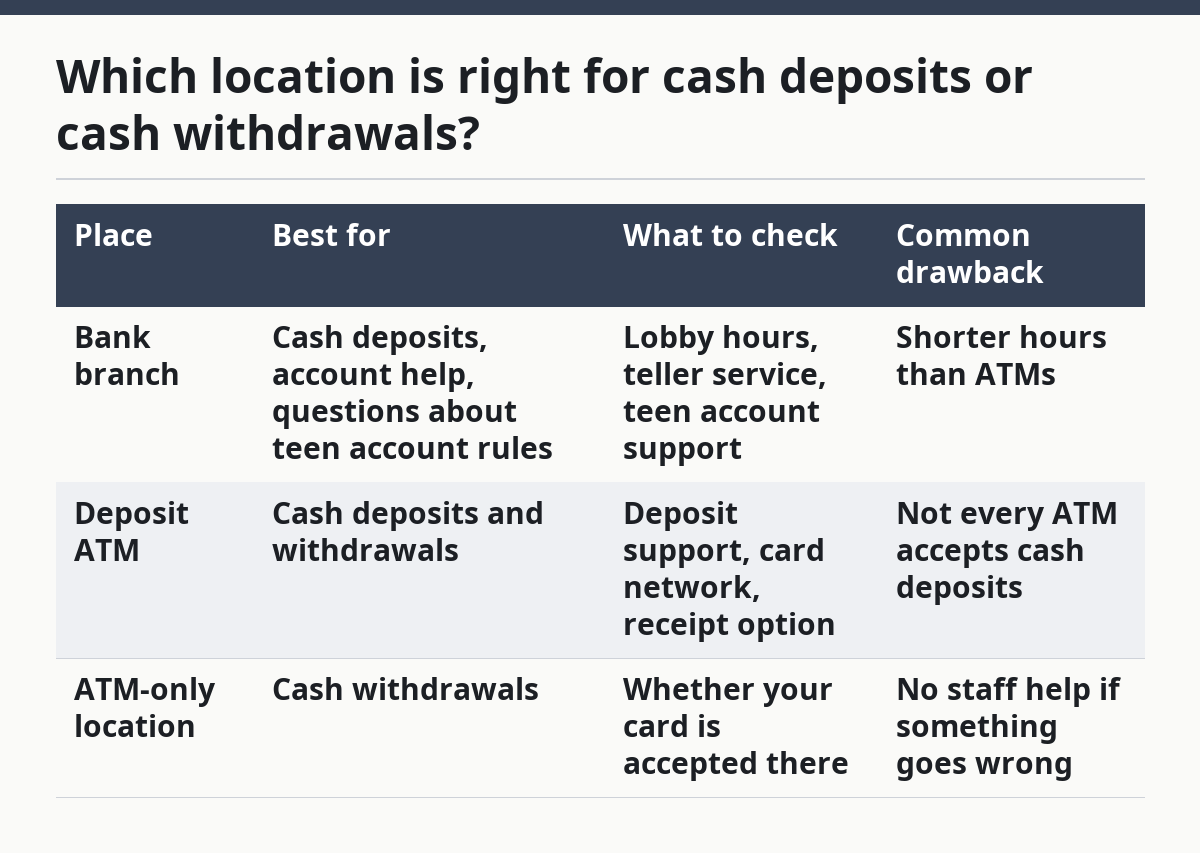
A branch can help if you are not sure whether your teen account allows a certain deposit method. An ATM may work for a fast withdrawal, but many machines do not support deposits at all, and some that do may only accept them during certain hours or at certain locations. The FDIC’s consumer banking guidance is a good place to check general account safety and access basics if your teen account terms are unclear.
The trade-off is simple: branches offer more flexibility, while ATMs offer speed. If you need staff, a receipt, or a question answered, choose the branch. If you only need cash and already know the card works, choose the ATM.
What should I check before I go?
Check the bank locator details, branch hours, and ATM notes before leaving, because a location can be close and still be the wrong fit. A five-minute check can save a dead trip across town.
Look for these items in order:
- Hours: Branch hours are often shorter than ATM access, especially on weekends or evenings.
- Service type: Full-service branch, lobby branch, drive-up branch, or ATM-only.
- Deposit support: Some ATMs take cash deposits; many do not.
- Withdrawal support: Make sure the machine accepts your card network.
- Teen account notes: Some accounts have extra rules on card access, cash limits, or parental controls.
- Location type: Inside a grocery store, in a shopping center, at a campus branch, or in a downtown lobby.
For a teen account, the hours matter more than they do for a standard adult account because teens often need a location near school, work, or home. A branch near a suburban shopping area may have longer parking time but shorter lobby hours. A downtown branch may be easy to reach by bus but harder to use after school if the lobby closes early.
If the locator is vague, call the branch and ask one direct question: “Does this location handle teen account cash deposits or cash withdrawals, and what are the hours for that service?” That single question gets you more useful information than asking whether the branch is “open.”
How do I know which ATMs work with my card?
You know which ATMs work with your card by checking your bank’s ATM network, the ATM label, and the locator details before you leave. If the machine is in your bank’s network, it is more likely to support the card on your teen account, but the locator still matters because some machines only do withdrawals, not deposits.
The most useful signs are practical, not fancy. A machine that shows your bank’s name on the locator page, lists your card network, or is marked as part of your bank’s ATM network is a better bet than an unmarked machine at a convenience store. If the locator lists a shared network, that can also be a match, but you still need to confirm whether the machine allows the transaction you want.
One good habit is to check the exact location name, not just the street. A branch lobby ATM, a drive-up ATM, and a retail-store ATM can all sit in the same ZIP code and still behave differently. The same is true in college towns, downtown blocks, and suburban shopping centers where one bank may have several machines within a few miles.
A card that works for withdrawal is not automatically good for cash deposit, so do not assume both will work. That is the biggest mistake teens make when they are in a hurry. If your bank locator does not clearly say the ATM accepts deposits, treat it as withdrawal-only until you confirm otherwise with the bank or the branch staff, or check the bank’s ATM details page.
What if I need a branch near school, work, or home?
Pick the branch or ATM that matches your daily route, because the location that works best is the one you can reach when the account needs attention. For a teen, that usually means near campus, near a job, or near the neighborhood where you already spend time.
This matters because branch hours and ATM access do not line up with a school day. A location that is perfect on a map may still fail if you can only get there after class, after practice, or after a shift. A branch near a bus line or shopping center may be worth more than a branch that is physically closer but harder to reach.
Use the locator for a 2-step filter: first by service, then by travel pattern. Search for branch services first if you expect to need help with a teen account, then compare the closest 2 or 3 locations by hours. If you only need cash withdrawal, compare ATMs by network and access hours instead of distance alone.
This page is also the right place to think about nearby towns or suburbs, not just your own block. If you live on the edge of one town and school is in another, the right ATM might be across the district line but still closer in practice. That is normal, and it is one reason a bank locator beats a generic map search. See the bank locator guide for a step-by-step search checklist.
When should I choose a branch instead of an ATM?
Choose a branch instead of an ATM when you need certainty, staff help, or anything beyond a simple cash withdrawal. That is the better choice for teens who are still learning what their account can do and do not want to waste a trip.
A branch is the better fit when you need to:
- confirm whether a teen account allows a certain transaction,
- make a cash deposit that requires staff attention,
- fix a problem with a card or account access,
- ask about hours before you arrive,
- or use a service that is not listed on the ATM screen.
An ATM is the better fit when you already know the card works, the machine is in network, and the task is limited to cash withdrawal or a deposit that the machine clearly supports. If the locator is unclear, choose the branch. The extra few minutes are worth it when the alternative is a declined transaction or a closed lobby.
This is also the point where a teen account can be more limited than a standard account. That is not a flaw; it is part of how teen banking is set up. The downside is less freedom at some locations. The upside is that the rules are usually simpler when you know which branch or ATM you need.
Where can I check trusted bank and ATM rules?
Check the bank’s own locator first, then verify general account and ATM rules through a consumer finance source if the details are confusing. The bank knows its locations; the regulator or consumer resource helps you understand the rules around access and account features.
Two solid places to start are:
- the FDIC for general banking and deposit account guidance: https://www.fdic.gov/consumers
- the Consumer Financial Protection Bureau for account and debit-card basics: https://www.consumerfinance.gov/consumer-tools/bank-accounts/
Those pages will not tell you which branch is closest to your house, but they do help you understand what a branch or ATM can and cannot do with a teen account. That matters if the locator uses terms like “cash deposit,” “cardless access,” or “network ATM” and you want to know what they mean before you go.
The honest limitation is that no outside source can replace your bank’s own locator for a specific location. If the locator says a machine accepts deposits and the branch lists lobby hours until 5 p.m., that is the information to trust for that day. General guidance helps you interpret it; the locator tells you where to go.
What is the safest next step?
The safest next step is to use the locator, check the hours, and confirm the exact service before you leave. That routine avoids most problems with teen accounts, because the issue is usually not the account itself but the wrong location for the task.
If you are unsure, start with the branch. A branch gives you the widest range of help, while an ATM gives you the narrowest. That makes the branch the better choice for first-time visits, cash deposits, or any situation where you do not want to guess.
If the location is near school, work, or home, write down the hours and the service type before you head out. One minute of checking can save a 20-minute detour, and for a teen account, that is often the difference between getting the job done and waiting until another day.
What if my bank locator shows several nearby locations?
Pick the one that lists the exact service you need, not just the closest pin. A branch with full-service hours is usually better for account help, while an ATM with deposit support is better if you only need to handle cash.
Can I use any ATM if it is close by?
No, because proximity does not guarantee card compatibility or the right transaction type. Some ATMs only handle withdrawals, and some are outside your bank’s network, which can make them a poor match for a teen account.
Is a branch always better than an ATM?
No, because a branch is slower for a simple cash withdrawal. A branch is the right choice for questions, deposits, and account help, but an ATM is usually the better pick when you already know your card will work.
What should I do if the locator is unclear?
Call the branch and ask whether it handles teen account cash deposits or cash withdrawals, plus the hours for that service. A short call is better than guessing, especially if you only have one trip to make that day.
Drafted with AI; not yet reviewed by a person.