Last updated: August 10, 2026
FTC disclosure: If you buy through links in this article, I may earn a commission at no extra cost to you.
Key facts / key takeaways:
– Allowance vs earned income teens: what’s difference? Allowance is usually fixed and scheduled; earned income is tied to work.
– A 2023 FINRA Foundation study found that 43% of teens aged 13 to 17 had a savings account, a reminder that regular money habits start early.
– The U.S. Bureau of Labor Statistics reported that 36.8% of 16- to 19-year-olds were employed in July 2024.
– A teen can use allowance for budgeting practice and earned income for work-and-pay practice.
– To avoid turning every household task into a wage negotiation, keep allowance and paid work separate.
Verdict box: If your goal is to teach a teen money habits without tying every dollar to chores, an allowance wins; if your goal is to teach the link between effort and pay, earned income wins.
A teen with $10 in hand on Friday is already learning something. The lesson changes fast depending on where that money came from. I write about family finance because the hardest part is rarely arithmetic; it is choosing which habit you want to build first — budgeting with a fixed amount, or connecting work to pay in the allowance vs earned income teens: what’s difference?
Quick answer: allowance and earned income are not the same thing
On a schedule, a parent or guardian gives allowance without tying it to a specific job each time. Earned income works the other way: the teen does work and gets paid for it, whether that work is babysitting, mowing lawns, tutoring, dog walking, or a part-time job.
Simple? Yes. Thin? No. The distinction changes the whole lesson. Allowance teaches planning and delayed gratification; earned income teaches labor, responsibility, and the reality that income can rise or fall with effort and opportunity.
Here’s the part many articles skip: families usually need to solve a particular problem, not win a theory contest. When a teen burns through cash on impulse, a predictable allowance may work better because it gives them a safe place to practice. If a teen expects money without understanding effort, earned income may reset the frame. Sometimes both belong in the same house. One handles the basics; the other covers extras.
Side-by-side: the decision that actually matters
The real question is not “money or no money?” It is how the money shows up, and what behavior it is supposed to teach.
| Topic | Allowance | Earned income |
|---|---|---|
| How money arrives | Set amount on a schedule | Paid only when work is done |
| Main lesson | Budgeting and delayed gratification | Work, responsibility, and income replacement |
| Predictability | High | Lower |
| Best for | Younger teens or beginners learning money habits | Older teens preparing for jobs or side work |
| Risk | Can feel disconnected from effort | Can turn every family task into a negotiation |
| Parent control | High | Lower |
| Motivation | Habit-building | Incentive-building |
That table looks tidy, but family life rarely is. One system feels more orderly; the other feels more like the outside world.
What allowance really teaches
Use allowance when you want a teen to practice handling money before the stakes get high. Honestly, I like it as a training budget. The same amount arrives on a regular cadence, so the teen can make choices, make mistakes, and live with the outcome without needing a paycheck each time.
Predictability is the whole point. A Friday deposit means planning is possible. The teen can split funds into spending, saving, and maybe giving. And the math is plain: $10 a week is $40 a month, while $20 a week is $80 a month.
Clear rules matter here. I would keep three things obvious:
- What the allowance is for
- What it does not cover
- Whether chores are expected separately
That third item causes the most friction. A common slip-up is blurring allowance with chores. A parent says, “You get money if you help around the house,” but never spells out which jobs count as normal family duties and which ones are paid extras. Then everyone gets cranky. The teen sees randomness. The parent sees bargaining. Ugly.
Allowance is not the right fit if you want a direct lesson about workplace effort. A teen can receive allowance without visible labor, and that may be exactly what you do not want if the goal is to show that income follows work. It can also make money seem like something that appears by family habit rather than by planning or earning.
What earned income really teaches
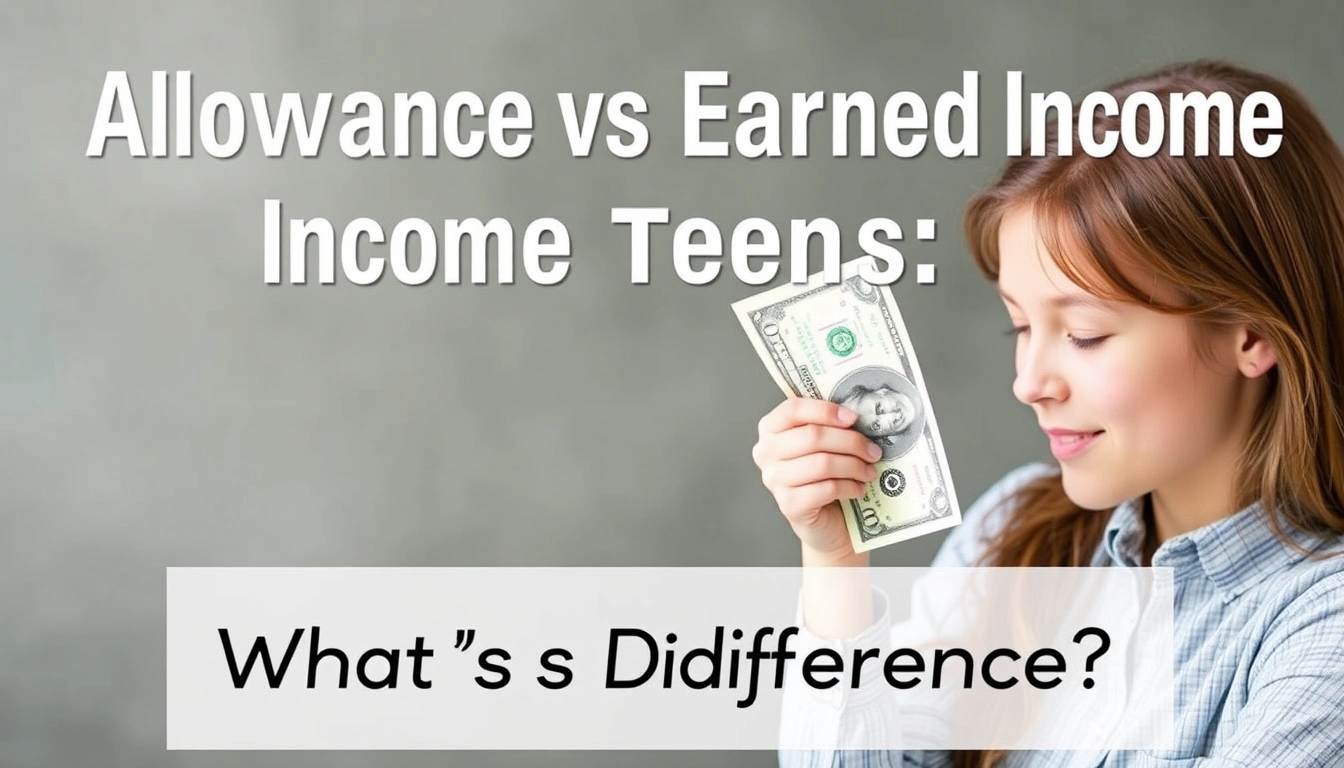
Work first, money second. That is the point. Earned income gives the teen a clear exchange, and that is powerful. It introduces a more adult idea of income. The teen sees that pay depends on showing up, doing the job well, and sometimes dealing with slow customers, cancellation, or seasonal demand.
In practice, earned income fits better once a teen is ready to understand value creation. Babysitting, lawn care, pet care, tutoring, freelance creative work, and part-time jobs all show that money often comes from solving someone else’s problem. The U.S. Bureau of Labor Statistics said 36.8% of 16- to 19-year-olds were employed in July 2024, which shows how common paid work can become in the teen years.
I think earned income has one strength that allowance cannot fully imitate: it encourages initiative. If a teen wants more money, they have to find more work, improve a skill, or market themselves better. That is a real-world lesson. Harder, yes. Better in some ways? Absolutely.
But there is a catch. Earned income can be uneven. One week can be busy, the next can be slow. That uncertainty helps if the teen is older and ready for it; it is rougher if they are still learning cash flow. A younger teen may see a slow week as personal failure rather than normal variation.
Earned income also becomes messy if every family chore turns into a billable event. I would avoid a setup where basic cooperation at home is always monetized. Some responsibilities belong to family life, not to a labor contract. No one needs a mini payroll department in the kitchen.
Which one wins on motivation?
Earned income wins if the goal is motivation through consequences. A teen usually feels the link between effort and reward right away. That can work especially well for teens who already like independence, side hustles, or goal-based saving.
Allowance wins if the goal is steady habit formation. A regular payout can cut down on arguments and keep the focus on budgeting instead of on whether the teen “deserved” the money that day.
Here’s my honest take: motivation is not the same thing as maturity. A teen who only works when cash is attached may get good at chasing paychecks and still miss basic money management. A teen who gets allowance may learn planning before ambition. Both matter. Different muscles.
Which one wins on real-life flexibility?
Allowance wins for simplicity. It is easier to manage, easier to explain, and less likely to become a weekly negotiation.
Still, simple can be too simple. If a parent sets the amount once and never circles back, the system can drift out of sync with the teen’s needs. Teen expenses change quickly. Sports, transportation, social plans, school events, and personal care all affect the budget. A $15 weekly allowance may cover snacks but not a school dance ticket or a haircut.
Earned income wins for flexibility in another sense: the teen can increase income by working more or finding better-paying tasks. But that freedom comes with uncertainty. It also depends on outside demand, which a teen cannot control. The wheel turns when it wants.
If you want calm at home, allowance is easier. If you want something closer to the outside world, earned income is more realistic.
Which one is better for teaching money management?
I give this round to allowance, but only by a narrow margin.
Why? Because money management starts with scarcity and choice. A set allowance creates a small, safe version of that. The teen has to decide whether to spend now or save for later. Waste it, and the loss is real. Save it, and the payoff is real too. The lesson lands cleanly because the amount is predictable. A teen who gets $20 a week knows exactly what is available.
Earned income teaches money management as well, but the work can overshadow the money. A teen may focus on getting the next job rather than on managing what is already in hand. That is not bad. It is just a different lesson.
If the teen is already motivated, earns irregular money, or has a side hustle, earned income can be a better practice ground for real-world budgeting. But for a teen who needs a clean first framework, allowance is often easier to use well.
Which one is better for teaching responsibility?
Earned income wins.
This is the cleaner fit. When money depends on work, the teen learns that responsibility is not just about remembering to spend carefully. It also includes showing up, finishing tasks, and dealing with expectations set by someone else.
The downside is plain: if you use paid work for everything, the teen can start seeing every request as a transaction. That can chip away at family cooperation. So I would reserve earned income for tasks that are truly extra or genuinely work-like, not for every normal contribution to the household.
Allowance can support responsibility too, just indirectly. It teaches the responsibility of managing what you already have. That is real responsibility. Different flavor, same seriousness.
Who should get allowance?
I would choose allowance for a teen who:
- needs a low-pressure way to learn budgeting
- gets overwhelmed by irregular income
- is young enough that work opportunities are limited
- struggles with impulse spending
- needs practice separating wants from needs
- benefits from a predictable routine
Allowance also fits well if your family wants to avoid constant negotiations about chores. You can decide that basic household responsibilities are part of being in the family, not part of a pay scheme.
Who should skip allowance: a teen who is ready to learn self-directed earning, or a family that wants every dollar tied to work. If allowance is handed out with no structure, no purpose, and no conversation, it turns into invisible money. That teaches very little.
Who should get earned income?
I would choose earned income for a teen who:
- is ready for a stronger work lesson
- wants extra money for specific goals
- already shows some reliability
- can handle uneven pay
- is old enough to take on real jobs or regular paid chores
- needs to understand that money often follows effort
Earned income also helps with teens who resist allowance because it feels “babyish.” Some teenagers do better when the money is clearly theirs because they worked for it.
Who should skip earned income: a teen who is too young to manage uncertainty, a teen who becomes defensive when money is tied to performance, or a family that is using pay to replace basic parenting. Not every task in a household should become a side hustle.
The hidden problem with mixing the two badly
A lot of families try a half-allowance, half-wage system and end up tangled. The teen never knows what is automatic and what is optional. The parent cannot tell whether they are teaching money management or paying for cooperation.
I would split the categories:
- Allowance = regular practice money
- Earned income = money for work beyond normal expectations
That separation keeps the rules cleaner. It also shields the parent from constant renegotiation. The teen can still learn that extra effort can bring extra money without turning the whole house into a workplace.
A simple way to decide
If you are stuck, ask one question:
Do I want my teen to practice managing money, or do I want them to practice earning it?
Choose allowance if the main goal is managing.
Choose earned income if the main goal is earning.
Choose a mix if your teen is old enough to handle both lessons without confusion.
My preference is straightforward: I would start with allowance when the teen is younger or inexperienced, then shift more responsibility into earned income as they mature. That creates a bridge from budgeting to work.
FAQ
Is allowance the same as being spoiled?
No. Allowance can be a teaching tool if it has rules, limits, and a purpose. It becomes a problem when it is handed out with no expectations and no lessons attached.
Is earned income always better?
No. Earned income teaches work, but it does not automatically teach budgeting or patience. A teen can earn money and still spend it badly.
Should chores always be paid?
No. Some chores are part of being in a household. If every normal responsibility is paid, a family can turn cooperation into a transaction.
Can a teen have both allowance and earned income?
Yes, and this can be a strong setup. Allowance can cover practice and earned income can cover extra goals or special work.
What if my teen only wants money, not the lesson?
Then the structure matters even more. A teen may not care about the lesson at first, but the system you choose will shape the habit they build.
Final verdict
If I had to pick one, I would choose allowance for the teen who needs money-management practice and earned income for the teen who is ready to learn work-for-pay.
The one condition that flips my answer is this: if your teen is already capable, motivated, and looking for independence, earned income becomes the better teacher. If not, allowance is usually the cleaner starting point.