Last updated: November 20, 2026
Key Takeaways
- You want the job, but you also need the details that keep day one clear.
- Reply with thanks, a yes or a request, and a written record of the terms.
- Get the title, start date, schedule basics, and pay details in writing before you accept.
- Confirm the role, the start date, and the next step in a message you can reread later.
A teen’s first job offer by text or email should get a calm, written reply that confirms the job title, start date, and hours before any first shift. How Teens Can Handle a First Job Offer by Text or Email starts with a written reply that asks for the details you need. Say yes in writing only after the offer has the details you need. The steps below show what to ask, what to confirm, and what red flags mean “pause.”
What to do first when the offer lands in your inbox or texts

Picture this: your phone lights up with a text from an employer, and you can see the job title, but not much else. You want the job, and you also don’t want to miss a detail that matters on day one. Your first move is to slow down and reply in writing.
A text or email offer can be perfectly normal for a first job, especially for part-time work, seasonal shifts, or local businesses. The catch is that a short message can leave out the parts that keep a job from turning messy later, like the start date, the pay rate, and the first-day location.
Here’s the simple rule: do not treat a casual message like a full offer until the employer has sent clear terms. If the message only says “You’re hired” or “Can you start Monday?” that is not enough to stop asking questions. A real offer should name the job title and give enough detail for you to know what you’re agreeing to. If you are unsure, ask a parent, guardian, school counselor, or another trusted adult to review it with you.
Use a short reply that stays polite and direct. Something like this works:
Thanks for the offer. I’m excited about the position. Could you please send the job title, pay rate, start date, work hours, and where I should report on my first day?
That one message does three jobs at once:
- it shows interest,
- it asks for the missing facts,
- it creates a written record you can refer to later.
Don’t fill in the blanks yourself. If a manager said “around 3 p.m.” or “probably next week,” those words are too loose for a first schedule. Ask for the exact time, exact date, and the name of the person you should check in with on day one.
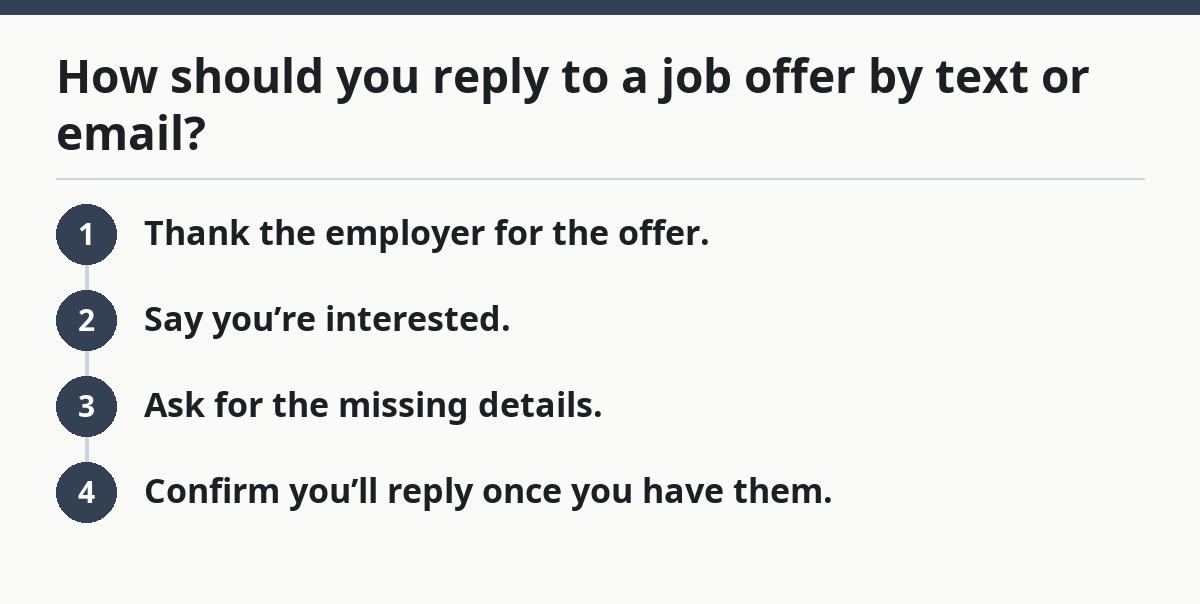
How should you reply to a job offer by text or email?
You should reply with thanks, a clear yes or a request for details, and a written record of the offer terms. That keeps the conversation moving and makes the next step easy for the employer to answer.
Picture this: you like the job, but the message is short and a little rushed. You don’t need a long speech. You need a clean reply that sounds professional enough to be copied into an email thread or screenshot later.
Use this basic structure:
- Thank the employer for the offer.
- Say you’re interested.
- Ask for the missing details.
- Confirm you’ll reply once you have them.
Example:
Thank you for the offer. I’m interested in the job and would like to confirm the job title, start date, work hours, and first-day details before I accept. Could you send those in writing?
If the offer already includes the main details, you can reply with a clear yes:
Thank you for the offer. I’m happy to accept the position of cashier. I confirm the start date is Tuesday, June 4, and my first shift is at 3:00 p.m.
That answer is short, but it matters. It gives the employer a written acceptance and gives you a message you can reread before your first shift.
Teens often get stuck because they think a text reply has to be casual. A job is still a job, even if the offer arrives on a phone at 7:14 p.m.
Use one screenful of thought before you send the message:
- Is the job title correct?
- Is the start date clear?
- Do you know the time and place for the first day?
- Have they said whether the pay is hourly, per shift, or something else?
- Do you know who to contact if you’re late or confused?
If any answer is fuzzy, ask again in writing. A vague offer costs time later, usually on the first morning when everyone is busy.
What details should be in writing before you say yes?

You should have the job title, start date, schedule basics, and pay details in writing before you accept. That keeps you from showing up to a first shift with the wrong expectations.
Picture this: the manager says “You start Friday,” but Friday could mean an opening shift, a closing shift, or a training block you weren’t expecting. The job offer message needs to pin down the parts that affect your time and your first paycheck.
Ask for these details if they are not already in the message:
- Job title and department
- Start date
- First-day time
- Work location
- Pay rate or pay method
- Expected hours per week, if known
- Uniform or dress code
- Who to report to on day one
A lot of first-job confusion comes from one missing line. For example, “Bring black pants” sounds simple until you realize the workplace expects black shoes too. A short written exchange can save a very awkward first morning.
If the employer uses email, keep the thread in one place. If the offer came by text, take screenshots and save them. That gives you the date, time, and wording exactly as they were sent. It also helps if you need to check whether the start date changed.
Here’s the catch: you do not need to sound suspicious to ask for details. You can sound organized. Try:
Before I accept, could you please confirm the pay rate, start date, first-day time, and where I should go when I arrive?
A good employer won’t mind that question. A disorganized one may answer slowly, but you still want the answer in writing. A 10-second text is cheaper than a 10-minute argument on day one.
For more on teen work basics, the hub guide on Teen Jobs, Income, and Work Readiness — The Complete Guide can help connect this step to the rest of the first-job process.
How do you accept the offer without creating confusion?
You accept the offer by confirming the role, the start date, and the next step in a message that can be read later without guessing. That way, both sides know the offer was accepted and what happens next.
Picture this: you’ve asked your questions, the employer replied, and now the details make sense. This is the point where a lot of teens either say too little or say yes too fast. Keep it simple, and make your acceptance match the facts.
A clean acceptance can look like this:
Thank you. I’m happy to accept the offer for the part-time sales associate position. I confirm the start date is Monday, May 20, and I’ll arrive at 2:45 p.m. for my first shift.
If the employer has not sent pay details, do not pretend that part is settled. Say:
I’m excited to accept once I receive the written pay rate and first-day details.
That sentence is not rude. It’s careful.
Use an ol-style checklist in your own head before you hit send:
- Read the message again.
- Make sure the job title matches what you want.
- Confirm the start date and first-day time.
- Save the message or screenshot it.
- Send your acceptance in writing.
If the offer is in an email, reply to that same email thread so the whole conversation stays together. If it’s in text, keep your reply short and don’t split the conversation across different apps. One thread is easier to find than three.
A written acceptance helps most when plans change. If the employer later says the start date is different, you already have the original wording. That is why written confirmation matters more than a quick “okay” in the hallway or over the phone.
What are the red flags in a text or email offer?
Red flags are missing details, rushed pressure, and vague instructions that make the job hard to verify or track. Those signs may not mean the offer is bad, but they do mean you should slow down.
Picture this: the message says “You’re hired, start tomorrow, text me when you get there.” That might be normal for a small business, or it might be sloppy. The problem is not the tone alone. The problem is the lack of clear facts.
Watch for these warning signs:
- No job title
- No start date
- No clear work address
- Pressure to reply right now
- Instructions that only come by text and change often
- Ask-for-money language for uniforms, training, or supplies before the first shift
- A name that does not match the employer you applied to
A vague offer can cost you in time, money, or a wasted first day. If you show up at the wrong location or at the wrong time, that is not your fault alone, but it still creates stress and can make you look unprepared. According to the U.S. Department of Labor, teen workers are covered by wage and hour rules, and a clear record helps you keep track of them. The Federal Trade Commission also warns that unexpected payment requests can be a scam sign.
A 2023 Gallup report found that 70% of remote-capable workers did some of their work remotely, which is one reason written messages matter so much. In a text-only job offer, the words become the record.
The best move is to stay calm and ask one tight question:
Could you please confirm the job title, start date, first-day time, and work location in writing?
If the answer stays fuzzy after that, pause. A solid employer should be able to give you basic details in a few sentences. If the message becomes pushy instead of clear, that’s a sign to step back.
One more thing: if a message asks you to share private information through an odd link or a strange app, stop and verify the contact path through the company’s normal website or hiring channel before you reply. That’s not about being difficult. It’s about not handing your details to the wrong place.
The short checklist teens can use before day one
You should end the conversation with a written record that says what the job is, when it starts, and where you’re supposed to go. That’s the cleanest way to avoid first-day confusion.
Picture this: it’s the night before your first shift, and you’re trying to remember whether the job starts at 8:00 a.m. or 8:30 a.m. You shouldn’t have to guess. A good final message gives you something you can open in two seconds.
Use this final check before your first day:
- The job title is correct.
- The start date is written down.
- The first-day time is exact.
- The work location is clear.
- You know who to contact if you’re running late.
- You saved the text or email.
If any of those items are missing, ask before the start date, not after. A 1-line message on the day before is enough:
Just confirming tomorrow’s start time and the address for my first shift. Thanks.
That tiny check can spare you a bad first impression. It also helps if your parent or guardian needs to see the details, since many teens share rides or need help planning the first day.
The key is a clear reply, not a flashy one. Clear words now beat awkward corrections later.
What if the offer feels rushed or incomplete?
You should pause and ask for the missing facts if the offer feels rushed, because a fast message is not the same thing as a complete offer. That protects your time and gives you a chance to decide with clear details.
Picture this: you get a text that seems exciting, but it leaves out the pay rate or the exact start time. That does not mean you must say no. It means you should slow the pace until the message is complete enough to understand.
A rushed offer often looks like this:
- “Can you start tomorrow?”
- “Text me when you can.”
- “We’ll explain everything later.”
- “Just show up and we’ll see.”
Those lines may sound casual, but they shift all the risk onto you. You’re the one who has to figure out the schedule, the location, and the plan. That is not a fair setup for a first job.
Reply with a simple boundary:
I’d like to review the written details first, including the job title, start date, hours, and first-day location.
That answer is calm and firm. If the employer respects it, good. If they push back hard over a basic question, that tells you something useful before you’ve committed to the job.
A first job should start with clear terms, not a guessing game. The message itself can be short, but the details should not be.
Should I accept a job offer by text?
Yes, if the text clearly includes the job title, start date, and enough details for you to know what you’re agreeing to. If the text is too short or vague, ask for written confirmation first.
A text offer is common for a first job, especially with small businesses and part-time work. The key is clarity, not the app. Save the message, reply politely, and make sure you know when and where to start.
What should I ask before saying yes?
Ask for the job title, start date, first-day time, work location, and pay details if they are missing. You should also ask who to report to on day one and whether there is a dress code or uniform.
Keep the request short. A single text or email can cover all of it, and the employer can answer in the same thread.
Do I need written details before starting?
Yes, you should have the basic details in writing before your first day. That gives you a record of the schedule, the location, and the role in case anything changes.
Written details do not have to be a formal contract for a simple first job. A clear text or email thread is still better than memory alone. If the employer won’t put the basics in writing, slow down and ask again.
Drafted with AI; not yet reviewed by a person.